


Ronald Barney: The Reliability of Mormon History Produced by the LDS Church
Update: August 21, 2009- Transcript is now available from FAIR here.
Barney is coeditor of volume five of the Documents Series of The Joseph Smith Papers.
He has history degrees from Weber State and Utah State Universities. He
has been employed since 1977 as an archivist and historian in the
Church History Department of The Church of Jesus Christ of Latter-day
Saints. The following are my imperfect notes only.
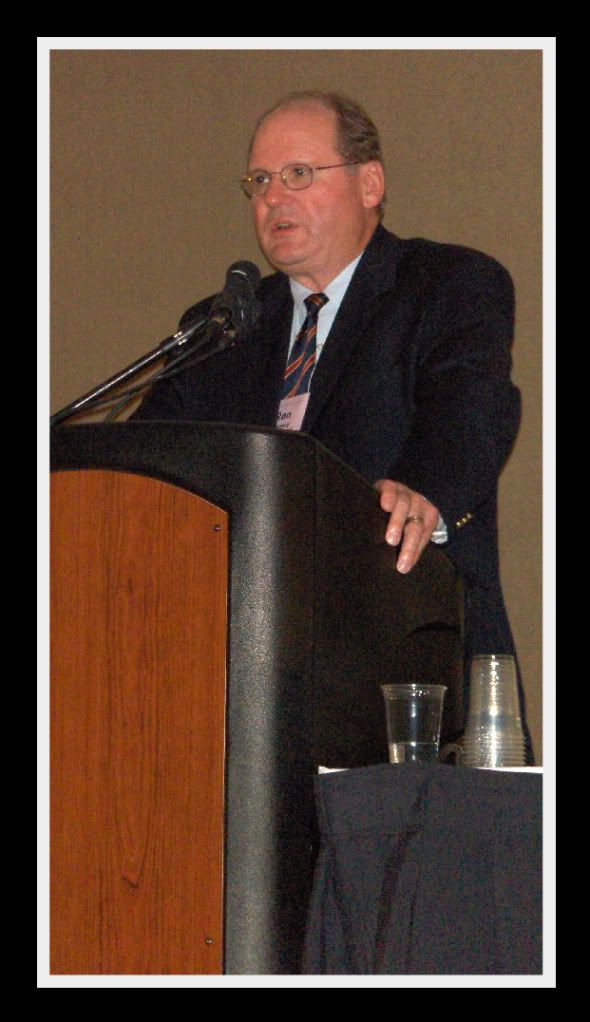
The historical department was moved and reconstituted with a professional staf a few decades ago, it was multi-tiered, not just Leonard Arrignton and those individuals, but also archivists, etc. who served as a platform whereby the Church could not only produce an excellent history but also ensure it was defendable.
1984 milestone when one member of the staff published Personal Writings of Joseph Smith. Dean C. Jesse. He was assigned to do JS personal writings. The first edition was compromised because it included some Mark Hofmann forgeries so it lay dormant until 2002 when a 2nd edition came out with close attention to detail, etc. Forgeries were removed, additional findings were included. A remarkable volume, I think when people ask me to recommend 5 vol.s on JS this is one I always recommend. This was followed up by his intention to publish the papers. A 6-8 volume set. But he was doing it alone. First volume in 1989, dealing with autobio and historical writings, and then the first vol. of diaries in 1992. The project stalled for various reasons, and until the end of the 90s it stalled until Ron Esplin jump-started the project again.
The new project, as many as 59 people working on at a time, 22 full-time currently, the first volume of the journals came out last Fall, and volume two is coming out in September. I know something about the rigor that has been applied to ensure these will have a long shelf life. I don't believe we have to make any apologies about it; the scrutiny applied by outside readers, the dozens of reviewers to ensure accuracy and defendability, etc. We are very comfortable in that process. Still trying to streamline the process but it should come out as planned.
Want to talk about one of the most significant things the church has done in its history. There was a new copyright law in effect Jan 1, 2003. In order to undermine the efforts of people who did not own church documents who were having unrestricted publication access to some of the things we believe are very important, we decided to publish many of our documents in a way that we could create a copyright for them for a generation or so. A very ambitious project to produce selected collections from the Churchf archives. A two-volume dvd set, 31 collections are represented here, including totality of JS collection, GASmith collection, and others. Included manuscript of the History of the Church, the office journal. It would be hard to overstate the importance of these documents to the Church and a study of its history. Also the Journal History of the Church, over a thousand volumes. All told, over 74 DVDs. (Originally over 700 cds). 450,000 scanned document images. In the forthcoming volume of JSPP there will be
Recently, the MMM book was published, written by Ronald Walker, Rick Turley and Glen Leonard. The Military Book Club said the book examines questions more deeply than any previous book. A scholarly, even-handed, thorough, objective analysis.
"That is the kind of things that will be coming from the church in the future."
Western American Literature called the book distinctive because of the depth of research, which was also supported by church leaders who wanted full disclosure. Everything that could be made available was made available. I think we will see much more of this kind of production in the future.
The church moves at a bit of the slower pace than perhaps an independent organization does. But there is so much care and attention to detail applied, we want what we do to become bullet proof so it can withstand an agrressive -I wanna choose my words carefully here- an aggressive alternative.
There were some derivative products that came from our work on the JSP. I want to mention a few. For example, the creation of a new press: The Church Historians Press which will be documaentary, but eventually could have narrative history as well. There are several other documentary related projects lined
We have a website for the JSPP. Everything we produce in textual print will end up on the site, obviously with a time-lapse.
The JSPP is similar to other projects, like George Washington, Thomas Jefferson, Benjamin Franklin, etc. We are doing things that fit in the norm with most recent and careful scholarship in American historical studies. About 30 volumes between 5-700 pages. (Next vol. is more than 700.) Eleven are currently in production. One for next year, and hopefully two per year after.
Received generous funding from Larry Miller. His family is also under-writing the website, and for the last year and a half also underwritten the documentary we have on KJZZ TV, weekly, on the scholarship and research we have done. The intent is that the same day Rev. 1 comes out, the fiorst season of 52 episodes will be published by Deseret Book.
The new priesthood, relief society manual. We highlighted some of this work on the tv special. To show you the care and attention that went into this. As much rigor as you can imagine was indeed supplied.
Background about why this is such an important book in a historical context. Even though the Teachings of the Presidents of the Church series is not a history book, it is a book of teachings that are applicable today. But how has the church collected the teachings over time?
The first compilation began in Times and Seasons March of 1842, History of Joseph Smith, published in Deseret News in 1859.
Next, "Sermons and Writings of the Prophet Joseph" in The Contributor (1881-1883). This was the MIA organ.
1882, Franklin D. Richards and James A. Little, A Compendium, "Gems from the history of Joseph Smith," which contained excerpts of earlier History of Joesph Smith.
1902-1909, Joseph Smith, History of the Church of Jesus Christ of Latter-day Saints, B.H. Roberts, ed., 6 vol., (SLC: Deseret News).
The most impoortant publication the Church has ever done. Edited by B.H. Roberts. I do not believe we can overstate the importance of this work. It set the doctrine, the knowledge about Joseph Smith, it was so important.
The year that the 6th vol. came out there was a little volume by Edwin F. Perry JS's Teachings: A Classified Arrangement...
1938- TPJS compiled by Joseph Fielding Smith. Noted by teachers in the church as the number one influential book in teaching, etc.
Alma Burton, Discourses of the Prophet Joseph Smith (1956)
Andrew F. Ehat, Cook, 1980, Words of Joseph Smith. "This is a big deal. Where all of the other comp. prior to that time and subsequent are exerpts and topically, these authors published all of the sermons that existed at the time in total during Nauvoo 1839-1844, I think 173 sermons represented, only a fifth or so of all his sermons wound up here, had enough substantive text. Most all of those are here. A new edition is inthe works.
Robert Millett, 1989, Joseph Smith: Selected Sermons and Writings.
1997, 2000 Larry Dahl, Donald Q. Cannon, Encyclopedia of Joseph Smith's Teachings. "Worth a purchase topically."
The way in which we determined the way we would prepare the manual for PH/RS, we needed to get our head around what we really wanted to do and how we could properly prepare it. A book that influenced me is one regarding Abraham Lincoln. In 1996, 200th anniversary of his birth, (there are a ton of books on Lincoln). Recollected Words of Abraham Lincoln, Don E. Fehrenbacher and Virginia Feh. He took the things people said Lincoln said, and he came up with a list to determine accuracy. From their book:
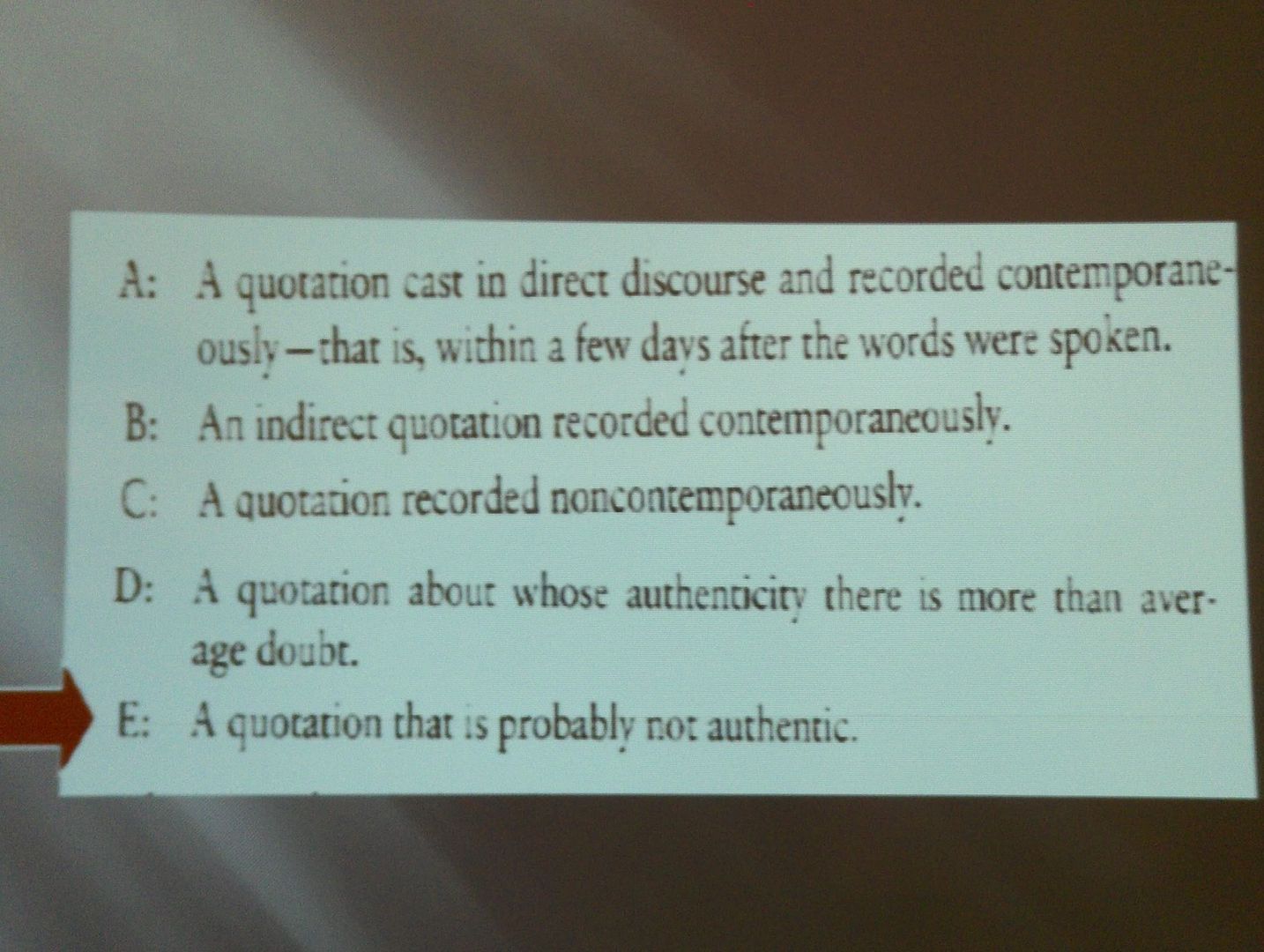
It creates a level of expectation about what you read, and you think twice about the texts that maybe normally, appearing in print, seem to have a level of credibility. So because I was given the charge to pull these documents together I decided to do the same thing with JS. So we formed a little committee and created a similar standard to consider. The curriculum comittee could look at a glance and know if they could include it. A Classification system. Ours was a bit different from the Fehrenbacher's.
[I transcribed this document from the KJZZ TV shown and it can be found here]
5 October 1840 sermon on priesthood seems to have been a dictated text, though it was not delivered evidently, a clerk gave the sermon.
Where would we be in the absence of note-takers? I can't imagine! Typescript of Bullock's notes can be read through in 17 minutes, but the sermon is said to have lasted 2 hours, etc.
Took into consideration the rocky relationship of William Smith to the Church and Joseph to consider that.
Showed some examples that are rated, C1+, B1+, etc. It filled 17 3-inch binders which were made into e-database passed on to the writing committee to produce a manual that has great power, it would be foolish to ignore.
We need to look at the historical
You shou;ld scrutinize what I am telling you today, if we're so lazyto accept whatever someone else says because they have a white shirt on...we;ll that sounded too...[laughter] someone in a tie and coat, we can't be lazy like that. This religion is too important. I have a stronger belief in JS and his divine appointment, I've worked for thew Church for 32 years and I feel more sure about the truthfulness than I ever had. We do not have to cut corners, this really is the kingdom and there are men who really do have keys that really were handed to them by JS and really were handed down. I am banking the rest of my eternal future on it and I am entirely comfortable. I didn;t plan to bear a testimony but I have one.
Jan Shipps once wrote an article called "The Prophet Puzzle." Many have used this to scrutinize this to see if JS was, as Dan Vogel said a "pious fraud," or a "man who had authentic experiences who represented himself in a real way" as Bushman argued in Rough Stone Rolling, and Jan Shipps raised the question where the truth is. I think it is worth creating a literature that shows we are careful about the question. Well she called it a prophet puzzle. Each facet of this puzzle represents facts, but it depends how it is arranged to see what the conclusion will be. It can be arranged in a way to make it not familiar to a pattern. Others might make it very tight and tidy and maybe that doesn;t represent it accurately either. Sometimes we do that, and I don't think it does us any favors. There are all kinds of ways to do it. If we are brave enough, and have confidence enough, as we place these things together, as we create from historical info, the impossible past that we really don't have a chance to replicate entirely but must give a best shot, we may come up with something attractive and compelling and causes us to look at our religion in new ways. We will find in so doing, an entity that must be defendable because of its importance in the world in both mortal and immortal realms. I think it's worth any kind of trouble we take to wnsure we do this right. He is worth all of the effort required for us to understand him. He has won me over in every way, and I say that in the name of Jesus Christ, Amen.
Q: Common criticism is that church manuals avoid difficult issues including plural marriage. Will this change? Are church leaders aware of innoculation in classes.
A: Did I write this?
Q: How would you respond to the JS blessing to JS the III?
A: It was a Hofmann forgery. But there was something to the idea because BY made appeals to the sons saying they would be placed in rightful positions if they would join, Hofmann seems to have played upon it.
Q: Did other publishers want tpo print JSPP, if so, why did Church decide to do publishing?
A: There were several prestigious presses who wanted to do it, but one pushback was if we gave all the manuscripts they would have done it, but 15 years of publication at 2 volumes per year, some weren;t willing. We wanted to assert control, have final say, and hope that over time it will prove itself to be credible and predictable, respond to the hard questions, etc. It isn;t a fear thing, it was a decision that doing it on our own with a prestigious press though initially unknown, overtime the identity will do us well.
Q: Vogel preparing updated 7 vol HC
A: As far as I know, he is doing his edition based upon B.H. Roberts use of the Millenial Star as primary source, that's how I understand it, then annotate with Manuscript History. We are going to publish the original as well. Time will tell about who did the best stuff.
Q: Arrington related direct negative intervention by 12 to some of his stuff. Has this changed?
A: I can only say we have enourmous support for what we are doing and have a pass off on this from highest levels.
Q: If we are so open with our history why are people so surprised about polygamy, hat translation, etc.
A: Not enough time to talk about it, I don't understand why we can;t be as up front with kids as we can be with adults. We have to do it right, but our people are smart enough, faithful enough, I am very confident about that.
Q: Why paintings published with translation JS looking at plates, etc.
A: Good question. I don't have the answer. [Semed he'd like to see one]
A:
 9
Comments
9
Comments

